Neuroaesthetics in Wellness Hospitality
The Science Behind Spaces That Shape How We Feel, Heal, and Stay
Neuroaesthetics is transforming the $8.5 trillion global wellness economy by providing a science-backed framework for environmental design. Emerging neuroscience demonstrates that human brain networks evaluate physical structures within 3 to 4 seconds, driving unconscious biological changes in stress hormones, blood pressure, and emotional valuation. For hospitality developers and asset managers, integrating neuroaesthetics is an operational strategy that shifts wellness design from an aesthetic luxury to a high-performance asset that maximizes revenue per square foot and long-term guest retention.
What Is Neuroaesthetics? The Intersection of Brain Science and Spatial ROI
Historically, the design of luxury spas, wellness clinics, and hospitality venues has been treated as a subjective exercise in interior styling. Spaces were curated to look beautiful on a page, but their impact on human biology was rarely quantified. Neuroaesthetics changes this paradigm entirely.
As an emerging subfield of cognitive neuroscience, neuroaesthetics examines the neural underpinnings of aesthetic experiences. Simply put: it is the empirical study of how the brain perceives, processes, and biologically responds to visual art, architecture, and spatial environments.
For the hospitality sector, this scientific discipline bridges the gap between design and physical health. It proves that our interaction with a built environment is not passive. Instead, every corridor, lighting choice, material texture, and acoustic layer triggers a cascade of neurochemical events. When asset managers view wellness real estate through this lens, design transitions from an intangible expense line into a measurable, function-led driver of asset performance.
The First 3–4 Seconds - Why the Brain Responds Before We Think
Foundational research in cognitive neuroscience, including the pioneering work on unconscious mental processes by Nobel laureate Eric Kandel, reveals that an astonishing 95% of our brain’s predictive and evaluative activity occurs below conscious awareness.
When a guest crosses the threshold of a wellness space, their nervous system does not wait for conscious appraisal. Within the first 3 to 4 seconds, the evolutionary brain has already scanned the environment and formed a subliminal impression.
This rapid-fire survival mechanism means that before a guest can process the quality of the marble reception desk or receive a greeting from a staff member, their autonomic nervous system has already classified the space as either a sanctuary or a friction point. If the physical architecture signals environmental stress—through harsh lighting, echoing acoustics, or confusing navigation—the body enters a low-grade fight-or-flight state.
In wellness hospitality, guest satisfaction is inherently tied to physiological decompression. If your spatial layout forces the brain to spend cognitive energy navigating friction, the guest is already biologically resistant to the healing treatments they came to experience.
The Triad Network - The Architectural Blueprint of Human Experience
Human-building interaction is governed by a sophisticated neurological matrix known as the Aesthetic Triad Network. Formalized by neuroscientists such as Dr. Anjan Chatterjee (University of Pennsylvania), this framework demonstrates that our experience of any given space is the direct result of three interacting neural systems.
The Sensory-Motor Network
This network controls how we physically navigate and sensory-map a space. It processes the visual layout through the occipital lobe, monitors bodily positioning, and registers tactile feedback. It dictates whether a floor texture feels grounding, how scale and proportion impact body posture, and whether a ceiling height provokes a sense of expansion or claustrophobia.
The Emotion-Valuation Network
Centering on the orbitofrontal cortex and the brain's reward centers, this system assigns emotional value and resonance to our surroundings. It evaluates whether a space feels safe, rewarding, or emotionally flat. When a space triggers positive neural valuation in this network, it releases dopamine and oxytocin, instantly shifting the guest into a state of receptive rest.
The Knowledge-Meaning Network
This network filters our physical surroundings through the lens of personal culture, memory, and expectations. In luxury hospitality, this is where brand positioning resides. It is the system that connects a beautifully curated space to a feeling of deep belonging, local authenticity, and elevated sophistication.
By aligning these three systems simultaneously, a vertically integrated design approach ensures that the physical space acts as a seamless extension of the operational intent.
Environmental Stressors vs. Healing Spaces - The Physics of Spatial Alignment
When we break down the elements of a built environment, specific, science-backed design strategies emerge as proven tools to optimize the Aesthetic Triad Network.
Curvilinear Architecture vs. Rectilinear Friction
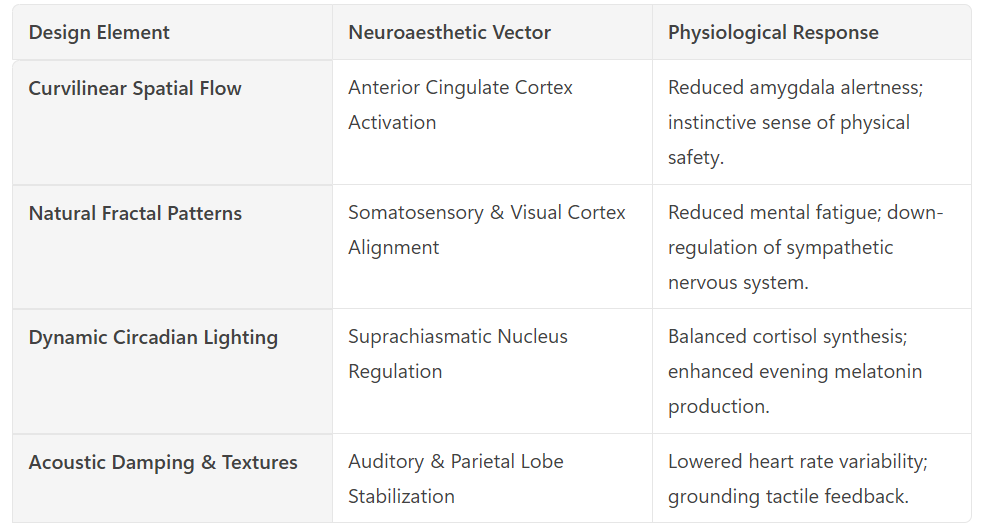
Neurological imaging shows a profound human preference for curvilinear environments over hard, sharp, rectilinear angles. Studies tracking brain activity via fMRI show that looking at sharp, geometric corners activates the amygdala—the brain’s fear and alert center. Conversely, sweeping, curved spatial flows activate the anterior cingulate cortex, a region associated with emotional ease and safety. Designing curvilinear corridors and rounded relaxation bays physically prompts the nervous system to let down its guard.
Biophilic Geometry and Fractal Rhythms
True biophilic design goes far beyond placing potted plants in a lounge. The brain is evolutionary tuned to respond to nature’s visual geometry, specifically fractals—nested, self-repeating patterns found in natural elements like fern leaves, water ripples, and wood grain. Exposure to natural fractal patterns reduces stress levels and mental fatigue by up to 60%, allowing the brain to enter a state of "effortless attention restoration."
Measurable Physiological Outcomes - Moving Beyond Aesthetics
The ultimate value of neuroaesthetics lies in its ability to generate predictable, repeatable, and biological outcomes. This is not subjective wellness marketing; it is clinical physiology.
Cortisol and Stress Regulation: Exposure to deliberately calibrated biophilic and sensory-optimized environments has been shown to decrease systemic cortisol levels by 15% to 20% within short exposure windows.
Cardiovascular Stabilization: Studies focusing on human-building interactions indicate that spaces with organic materials (such as unvarnished wood, local clay, and natural stone) lower resting heart rates and baseline blood pressure by shifting the autonomic nervous system out of sympathetic dominance (fight-or-flight) and into the parasympathetic zone (rest-and-digest).
Orbitofrontal Cortex Activation: When a space perfectly balances light, shadow, natural acoustic absorption, and tactile surfaces, neuroimaging demonstrates heightened activation in the orbitofrontal cortex. This is the brain's primary engine for emotional appraisal and reward, meaning that a well-designed environment physically creates a chemical feeling of luxury, deep satisfaction, and emotional restoration.
The Business Case - Why This Matters for Spa and Wellness Hospitality ROI
For investors, developers, and asset managers, every design choice must justify its impact on the pro forma. Historically, spa and wellness ventures have been treated as cost centers or low-performing amenities designed purely to support hotel room keys. They are frequently poorly planned, incorrectly programmed, and experientially disconnected from the start.
Neuroaesthetics bridges the gap between spatial beauty and longstanding financial performance. It functions as an operational mechanism that optimizes Revenue per Square Foot (RevPSF) in three clear ways:
Maximizing Dwell Time and Secondary Spend
When a wellness environment triggers the emotion-valuation network, guests enter a state of deep somatic comfort. This physiological comfort lengthens their "dwell time"—the amount of time spent inside the facility. In luxury hospitality, increased dwell time correlates directly with higher secondary spending on retail, food and beverage, and add-on aesthetic or medical treatments.
Elevated Perceived Value and Pricing Premium
Luxury consumers do not purchase wellness services based on transactional cost; they purchase based on perceived emotional transformation. An environment that triggers a measurable neurological shift within the first 4 seconds immediately validates ultra-premium pricing structures. The physical space itself establishes the premium, reducing client price sensitivity and maximizing the Average Daily Rate (ADR) of the wellness asset.
Transforming Amenities into Revenue Engines
By shifting from disconnected visual decorating to a function-led, performance-based spatial model, historically underperforming assets can be completely revitalized. Using data-driven neuroaesthetic principles ensures that every square foot of an asset is optimized for maximum therapeutic impact and operational efficiency, transforming a traditional underperforming hotel spa into a high-yield community membership engine.
This Is Not Decorating. It Is Strategic Asset Architecture
To successfully scale this science, asset managers must realign how they view the development process. Visual styling or "decorating" is a superficial treatment applied at the end of a project. Neuroaesthetics, however, is a foundational structural protocol that must be baked into the project's DNA from concept through construction.
When design, business development, and operational functions are viewed concurrently through one single lens, developers can avoid the critical spatial programming mistakes that cripple long-term operations. This holistic approach ensures that layout design, mechanical filtration, acoustic isolation, and lighting design support the business's bottom line while honoring the biological needs of the human beings inside.
Key Takeaways for Asset Managers and Hospitality Developers
Shift from Aesthetic to Metric Treat sensory architecture not as a visual line item, but as a performance-based asset that drives guest retention and primary spend.
Own the First Four Seconds Ensure arrival sequences, corridors, and primary lighting are strategically cleared of cognitive friction to down-regulate the guest's nervous system instantly.
Deploy the Aesthetic Triad Mandate that architectural teams design concurrently for:
Sensory-motor navigation
Emotional valuation
Authentic local meaning
Eradicate Operational Gaps Avoid beautiful but operationally broken floorplans. Use rigorous journey-mapping analysis to ensure neuroaesthetic pathways complement staff efficiency and service flow.
Objectivity, data, and neuroscience are essential foundations for building a sustainable, future-ready business. But science alone cannot fully capture the entire human experience.
At Core Essence, we believe that when you perfectly align the mechanics of human biology with the conscious architecture of a space, you create room for something deeper. We aspire for every environment and experience we touch to deliver a touch of magic—a touch of the unexpected. These are the spaces that are difficult to describe yet they are effortlessly easy to linger in, and they remain permanently held in the guest's heart and mind.



And A Touch Of Magic